Wednesday, August 10, 2011

Prairie Dock 2011

Three years ago I planted a small Prairie Dock seedling in the front yard.  It spent the first two years putting down roots.  Prairie Dock roots go very deep, reaching depths of 12 feet, making it a very drought resistance plant.  Finally, this spring it sent forth several huge spade-shaped basal leaves and a single stalk.  I knew this would be the year to watch the Prairie Dock grow above ground! 
In late June the stalk started to shoot up into the air.  It grew a foot over the course of a single week.  As of early August, it measured 10.5 feet from the ground to the tallest point!! 
It has survived several very strong windstorms, and the flowers are starting to open.


Saturday, August 6, 2011

Great Spangled Fritillary 2011

Don't butterflies have some great names?  This Great Spangled Fritillary was feeding at a Butterfly Milkweed plant.  The name "fritillary" refers to the black spots on top of the wings and the silver spots on the bottom.  Great Spangled Fritillary can be distinguished from other fritillaries by the dark zone near on the wings near the body.  The most common "fritillary" in the eastern U.S., it lays eggs on or near violets, which is why I try to leave my violets in tact even after they have finished blooming.

Friday, August 5, 2011

I&M Canal Boat Ride 2011

As part of my Christmas gift to my parents, I took them for a tour of the Illinois and Michigan Canal, which is part of the first National Heritage Corridor.  We took advantage of the canal boat tours out of LaSalle, Illinois.  Larry the Mule pulled the boat for a relaxing float back in time.  Here's a video postcard from the tour.

From 1848-1933, the I&M Canal connected the Illinois River at LaSalle with Lake Michigan, which effectively made Chicago the transportation hub of the nation by connecting the Mississippi River and the Atlantic Ocean.  Abraham Lincoln lobbied hard for federal funding for this project, arguing that this 96-mile canal would create a water passage for people and products that would benefit the entire United States.

The song I used for the video is from Gallimaufry's Dig Me A Ditch, a compilation of canal-related music.  When I called for a copy of the album, I was so sad to hear that Christine Gaylord, the driving force behind the group, had passed, but her husband Joe was very helpful in sending me a recording of his wife's legacy.  The whole album is full of superb folk songs, including many specific to Illinois.

Thursday, August 4, 2011

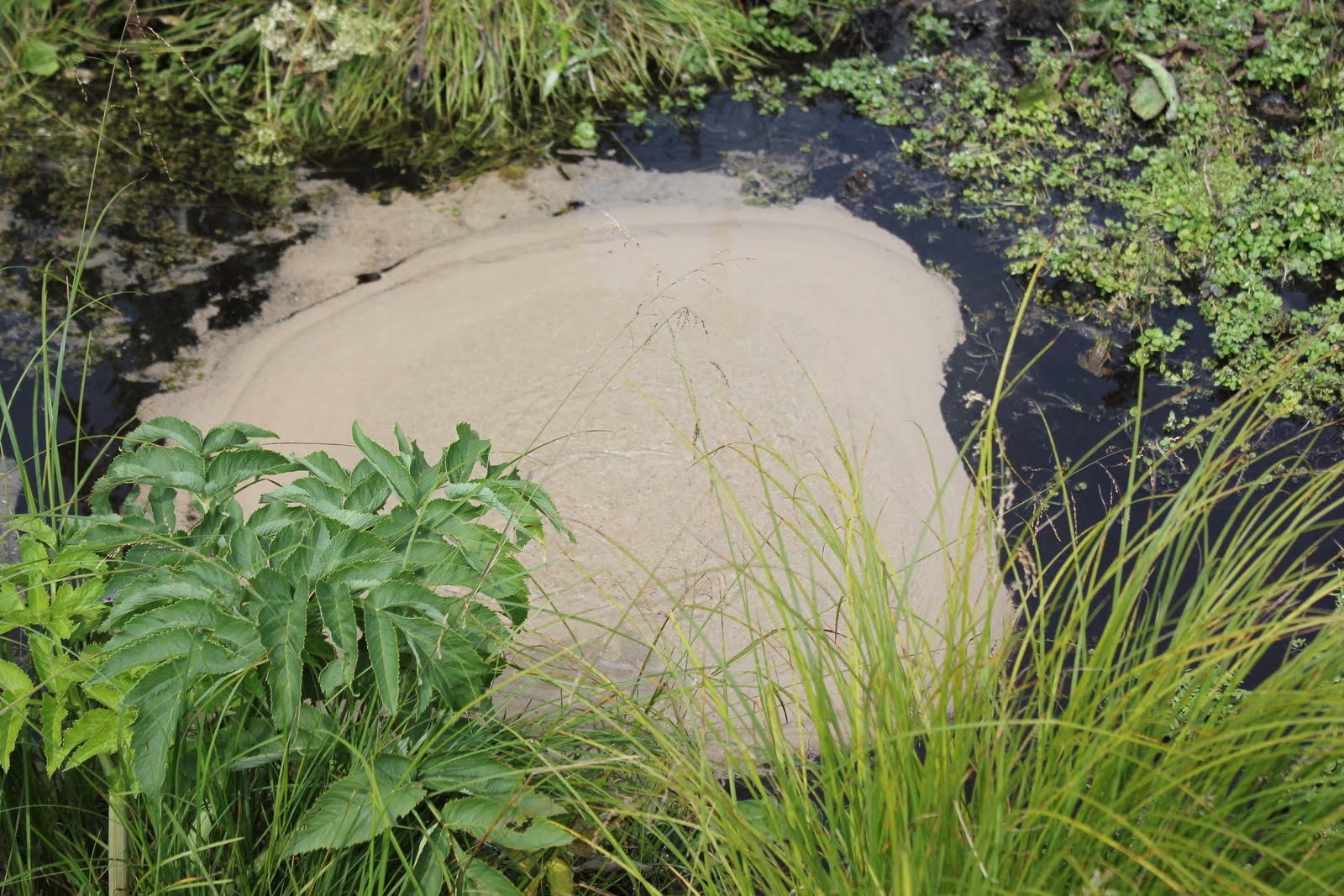
Nachusa Sand Boil 2011


One of the fun natural features at the Nachusa Grasslands is a sand boil.  Sand deposits from the Wisconsin era of the Ice Age are evident in many places at Nachusa, such as the sandstone outcroppings. 

The sand boil at Nachusa occurs at a natural spring.  It is caused when water under pressure pushes up through a bed of sand.  This sand boil is active in every season, even winter!

Animal-eating Plants!

During a trip to Pokagon State Park (Indiana), I learned about a carnivorous plant called Common Bladderwort.  It's a small, innocent-looking plant that you could easily miss. 

Apparently, the deadly part is underwater -- "little bags" or bladders that trap aquatic organism. Tiny swimming animals touch trigger hairs around the mouth of a bladder. A trap door opens and the bladder expands, sucking the prey inside. 

Common Bladderwort is found in bogs and marshes throughout North America, so watch out!

Sunday, July 24, 2011

Eastern Prairie Fringed Orchid 2011

It was 10 months in the making, but I finally found an Eastern Prairie Fringed Orchid.  These plants are state-endangered and federally-threatened mainly due to habitat loss.  Last fall when I was volunteering at the Nachusa Grasslands, one of the stewards pointed out an area where the orchids could be found.  I marked it with my GPS, so I would remember where it was.  The trick was showing up at the right time.  
I consulted Michael A. Homoya's Orchids of Indiana (because there isn't an equivalent resource for Illinois) and figured out the best time to return.  As confirmation, the Spring 2011 issue of Illinois Audubon magazine had an essay about this species of orchid at Nachusa. 

Joe and I picked our date to go looking and we followed our GPS waypoint back to the general location.  Even with all the advantages of timing and location, we still had to actually find a plant, which is like finding a needle in a haystack.  The most challenging part was wading through a thorny thicket and crossing a small stream.  It was worth all the blood and sweat we gave in exchange for a look at these spectacular plants!

Saturday, July 16, 2011

Peregrine Falcons at Millenium Park

To me, the best part of a summer concert at Chicago's Millennium Park is the the sky show put on by Peregrine Falcons.  These lightning fast birds of prey have been tracked at sky-diving speeds over 200 mph.  Last night, one falcon in particular perched on top of the shell of the beautiful Pritzker Pavilion to enjoy the concert led by Maestro Krzysztof Penderecki conducting his Concerto Grosso No. 1 and Beethoven's Symphony No. 3.  The falcon stayed in place for much of the concert.  But occasionally it would take off and zoom through the air with another PEFA. 
With 20 pairs in Illinois today, PEFAs are listed as an Illinois threatened species.  But 60 years ago there were none.  Due to the chemical DDT, they were entirely wiped out of their territory east of the Rocky Mountains.  Historically in Illinois, Peregrines were found along the Mississippi River between the cities of Alton and Grafton, as well as near the Illinois and Wabash Rivers in Jackson County. As a result of a reintroduction program that began in 1986, the urban landscape along Lake Michigan is now the best place to see PEFAs.
Pritzker Pavilion
For more information about the ongoing Peregrine Falcon reintroduction in Illinois, click this link to the Field Museum's Chicago Peregrine Program.