Sunday, November 11, 2012

Tundra Swans 2012


A few years ago, I heard about the annual migration of thousands of Tundra Swans along the Upper Mississippi River in early November.  This year I got to see over 10,000 swans.
 
 
The River is a gorgeous place.  Here's a view of it from Trempaleau National Wildlife Refuge.  and yes, this is the Midwest...it's not flat everywhere.  The power of water has done more than carve the Grand Canyon.  The bluffs in the background were formed by this ancient flow.
 

This group consists of three adults (the whilte ones) and three juveniles (the grey ones).   They were stopping near La Crosse, WI, from the breeding grounds in the high Arctic to their wintering grounds along the mid-Atlantic.    
 
They feed on the tubers in the riverbed like arrowhead, wild celery, and sago pondweed.  Those long necks make it easier for them to access the starchy bulbs.
 

Here's a video my sister and I took (most of it is from her).


Monday, August 20, 2012

Chicago Air & Water Show 2012

This year rain did not ruin the 54th annual Chicago Air & Water Show.  Last year when Alan came up from Indiana to watch it, we rode our bikes along the lakefront trail to a spot near Fullerton Ave., but we ended up spending 2 hours crowded under a bridge breathing boat motor fumes trying to dodge the spray from a windy downpour before we ave up and went home.  This year Alan brought Joan and the four of us took the bus to North Ave.  We arrived early in order to get a good spot.  The weather was ideal -- sunny with a light breeze off the lake.  We were front and center, and the show was incredible. 

Some 2 million people attended the Air and Water Show, the largest free public event of its kind in the U.S.  It started with the Chicago Fire Department's spray display on the lake.  The CFD Air/Sea Rescue unit serves 37 miles of lakeshore, extensive riverways, and Chicago's harbor system, which is the largest in the U.S.


There were various stunt planes.  The Lima Lima Flight Crew is a group of local pilots based in Naperville, IL.  They performed a variety of formations from the six ship wedge and double arrowhead to the basic finger four and diamond formations.


Here they are performing.


The U.S. Coast Guard performed a water rescue with a helicopter.  I have been grateful for the advice and watchful eye of the Coast Guard when paddling on Lake Michigan during 25 mph winds and choppy waters.  Fortunately, I have not personally tested their rescue skills.


A variety of stunt pilots also performed, including Jack Knutson and Rob Holland, the Firebirds from Ohio. 


For many people, the stars of the show were the Blue Angels of the U.S. Navy and Marine Corps.  The Blue Angels team is famous for the diamond formation and breathtaking daredevil stunts.


Their precision flying is also graceful.  In this video, you can even see the sun sparkling on the jets.


We had a great time.  As much as I love Lake Michigan, I usually avoid crowds, and I have never spent all day at the beach, but this show was worth it!  This year's show has special meaning because it marks the 200 anniversary of the War of 1812.  Here's a video postcard of the 2012 Chicago Air & Water Show. 


Saturday, August 11, 2012

Lake Michigan Dunes 2012

During the drought and heatwave of July 2012, Jill and Joe and I visited the Indiana Dunes National Lakeshore (IN) and Warren Dunes State Park (MI). 


A sturdy breeze brought welcome relief from the heat.


The high sand dunes are some of the most rugged and beautiful natural features along the shoreline of Lake Michigan.  Sand dunes in the Great Lakes region comprise the most extensive freshwater dunes in the world, so enormous that they can bee seen from space.  


At Warren Dunes we ascended 200 feet to the top of one of the sand dunes (above).  The shifting sand and blasting sun made the hike more difficult.  On our way up, we found a few rare Pitcher's Thistle plants, a federally threatend species endemic to the Great Lakes region (now extinct in Illinois except for a few reintroductions).  It was awesome to see these rare plants!


In Indiana and Michigan we hiked through oak-hickory woods.   At Indiana Dunes we walked through a virtual shrub forest of ripe wild blueberries. Small but flavor-packed fruit!   Eventually we made our way to the shore.
 
It was so much cooler by the lake.  What a beautiful, peaceful day!

Monday, June 25, 2012

Lead Plant & Mosquito-Eaters

A couple of years ago I planted a lead plant, a native prairie shrub.  This afternoon I noticed that one of the branches was in bloom for the first time ever!  The leaves of this shrub from the bean family are silvery.  The flowers are dark purple with bright orange stamens.
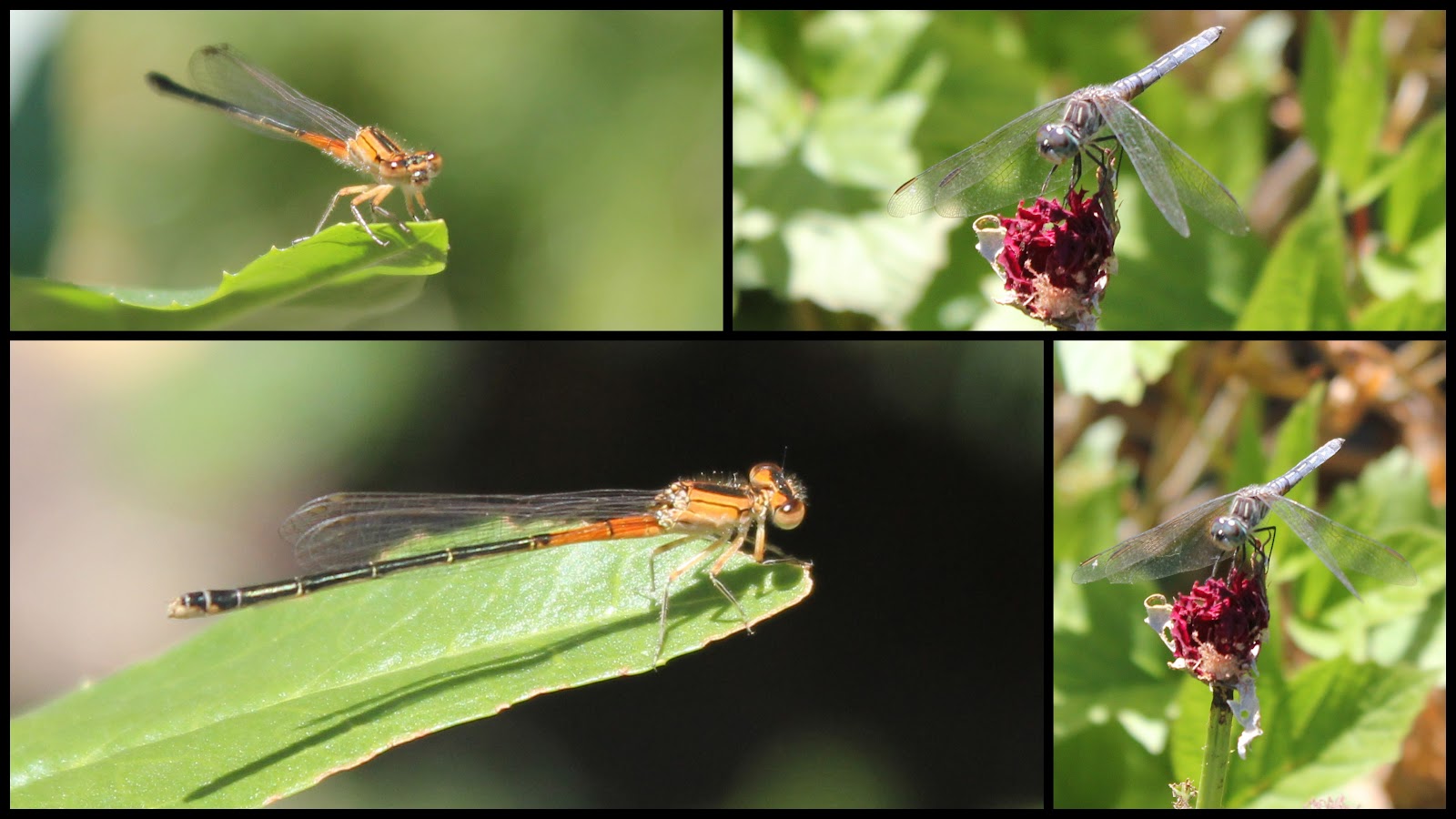
I also noticed a female Eastern Forktail damselfly perched on an Obedient Plant leaf (left below) and a male Blue Dasher dragonfly on a withered rose bloom (right below).  Both dragonflies and damselflies feast on mosquitoes.  Eat 'em up! 

Thursday, June 14, 2012

Cape Hatteras National Seashore 2012

Wind and waves are constantly shaping the outer banks of North Carolina.  We stayed in a beach house on the ocean (literally on the ocean, depending on the tide).  The first few days a nor'easter was blowing hard and churning the ocean mightily.  Later in the week, the sea was a little calmer.   
We enjoyed a couple of afternoons of paddling at the Pea Island National Wildlife Refuge where we collected some fresh shellfish for dinner (mussels, clams, and oysters).  The refuge was also a great place to see pelicans, terns, sandpipers, and other wading birds.  It's much easier to paddle at mid- to high tide, than at low tide!!
As we attempted to paddle (against a strong current) from the sound out to the ocean at New Inlet, we saw about a dozen large Horseshoe Crabs coming ashore to spawn.  More closely related to spiders than crabs, Horseshoe Crabs have been around for some 300 million years and lived 100 million years before the dinosaurs.  The males were hitching a ride with the larger females, who would burrow a nest into the sand to lay 90,000 eggs.  Apparently, less than 10 of those eggs per nest are expected to survive into adulthood.  During a 3-week window in the spring, about 11 species of migratory shorebirds en route from South America to the Arctic are dependent on the Horseshoe Crab for survival, consuming eggs from nests disturbed by storms and waves.   
The Gulf Stream mixing with the Labrador current creates strong storms and sea swells, which is why this area is called the "Graveyard of the Atlantic."  We visited 2 of the 4 lighthouses of coastal North Carolina.  The Bodie Island lighthouse (right below) was closed for renovation, but we climbed to the top of the Cape Hatteras lighthouse (left below), the tallest lighthouse in America.  We had planned to take the ferry to Ocracoke, but the effects of Hurricane Irene have made this an unreliable trip, so we opted out of venturing further south. 
We also visited the Wright Brothers National Memorial, site of the world's first airplane flight in 1903, and the remnants of Fort Raleigh, which is the site of the 1584 "Lost Colony of Roanoke" and the first English child born in the New World, Virginia Dare.
Although local politics was in full crazy mode (open hostility toward reasonable new rules by the National Park Service for Off Road Vehicles and adoption of an anti-gay amendment to the state constitution), this visit was both exhilarating and relaxing.  Since it was still off-season, the road and beaches were not at all crowded (the spit is so narrow, so there's only one road).   Enjoy this video postcard from the outer banks of coastal North Carolina.

Saturday, June 2, 2012

Shenandoah National Park 2012

Shenandoah National Park is on the the Blue Ridge of the Appalachian Mountains of Virginia, not far from Washington, D.C.  Four of us stopped there for a couple of nights on our way to North Carolina's Outer Banks.  Almost as soon as we got on the scenic Skyline Drive, Joe and only Joe saw 2 black bears.  I think the assumption was that if Joe saw these bears so quickly and so easily, then more would surely follow.  Although many hundreds of bears reside in Shenandoah, none of us but Joe saw any bears on all three days. 


We camped at the Big Meadows campground.  The white-tailed deer were fearless.  We were serenaded in the evenings by a chorus of frogs from the nearby wetlands and in the mornings by towhees, bluebirds, catbirds, and warblers.  Even Randy was awake early enough to hear them!  On our way to a wildflower walk on the Appalachian Trail with a park botanist, we found a Chestnut-sided Warbler singing his heart out at an overlook.  During the walk there were loads of spring wildflowers, due to the superabundant biodiversity of the Appalachains, which is one of the oldest mountain ranges in the world.  I really enjoyed seeing several ladybugs, which I hardly ever see in northeastern Illinois.  Two orchid species were a special treat: Showy Orchid and Small Yellow Ladies Slipper.  The botanist said that the orchids were blooming a couple of weeks early because of the unusually warm spring temperatures.     

Showy Orchid
Small Yellow Ladies Slipper
Besides the gorgeous scenic overlooks, another delight of the park was the waterfalls.  While we were at Dark Hollow Falls, it started pouring down rain, and it didn't matter that I had stepped in the water trying to get my waterfall pictures  -- we were all soaked from the uphill climb back to the parking lot.  
I hope you enjoy this video postcard from Shenandoah. 

Wednesday, April 25, 2012

Osprey Love 2012

Not only did I find two Ospreys (endandered in Illinois) at Tri-County State Park today, but I happened to see them mate. 

Last year I observed a pair in the same location, but the male had to be euthanized after a serious injury during a storm.  Perhaps this is the same female as last year, but with new mate.

Ospreys are also known by common names such as sea hawks, fish eagles, or fish hawks.  They are unique raptors on account of their diet of live fish and ability to dive into water to catch them.  As they hunt, they dive with their talons stretched forward.           

This pair of Ospreys built their nest on a powerline pole.  Manmade structures, such as telephone poles, channel markers, duck blinds, and nest platforms have helped to reestablish Ospreys in areas where they had disappeared.  It is encouraging to see another nesting attempt at this site after last year's tragedy.