Monday, September 12, 2011

Hennepin & Hopper Lakes (A Decade of Restoration)

On Saturday, September 10, 2011, The Wetlands Initiative celebrated 10 years of habitat restoration work on the Sue and Wes Dixon Waterfowl Refuge at Hennepin & Hopper Lakes in Putnam County.  It features a large cattail marsh, as well as other water-loving habitats.
Cattail Marsh at Hennepin & Hopper Lakes
By the end of the 20th-Century, about 90% of the wetlands in Illinois had been drained, ditched, filled, or levied off for agricultural, industrial, and recreational purposes.  But with the vanishing wetlands, we were losing a natural resource for cleaner water, flood control, carbon capture, biodiversity, as well as an economic and recreational resource.
Farmland in 2001
The Wetlands Initiative has set out to change that.  TWI Founder Al Pyott told how local residents wanted to see the Hennepin drainage district converted back to its former natural condition, a place where large flocks of ducks and geese would congregate during migration and with excellent fishing.  Part of the Illinois River watershed, the project has restored 2,600 acres of drained farmland to a native wetland.  The transformation is amazing.
Wetlands in 2011
The 10th Anniversary event encouraged a prolonged, "lazy" visit, including a 2-mile hike long the seep trail (from which our group saw 7 immature Bald Eagles roosting on snags over the water), a hike along the new boardwalk and into a moist sedge meadow, as well as a couple of hours of paddling out on the water.

Natural Seep
There were plenty of butterflies and dragonflies, as well as some great early fall flowers in bloom, including Stiff Gentian, Cream Gentian, lots of Great Blue Lobelia, Cardinal Flower, and an orchid called Nodding Ladies'-Tresses. 
Nodding Ladies'-Tresses Orchid

Dr. Gary Sullivan explained that most of the plants returned on their own, because the seeds survived 100 years of agricultural treatment such as disturbance, drainage, fertilization, and pesticides.  Only a few plants have been introduced.  The Wetlands Initiative just added water (and fire through a rotation of controlled burns).   
Cardinal Flower, a wetland jewel
Red Admiral Butterfly
For me, the very best part of the day was being out on the water.  I've been wanting to see the place from the water for over a year, and this was a perfect opportunity to do it. 
Least Bittern, an obligate wetland bird
Considering that full-blown duck migration is several weeks away and that other people were also paddling through the cattail marsh, we still saw a number of waterfowl and wetland birds, including Blue-winged Teal, Mallards, Canada Geese, Wood Ducks, Black-crowned Night Herons (state-endangered), a family of Common Gallinules (state-endangered) off the boat ramp, and a very close encounter with a Least Bittern (state-threatened).  Earlier this year in the spring, I saw hundreds of Canvasbacks and a male Yellow-headed Blackbird (state-endangered).  Clearly, this new habitat is appreciated by the migratory and breeding birds that rely on wetlands!

Here's a video postcard of my day at this beautiful place. 
The Refuge is open to the public year-round, thanks to The Wetlands Initiative!

Saturday, September 3, 2011

Revis Hill Prairie 2011

Revis Hill Prairie is an Illinois Nature Preserve in Mason County near Havana, located on the bluffs of the Sangamon River.  Only 412.5 acres, it remains the largest and best example of hill prairies in Illinois.

At the parking lot, there is an immediate incline up a sandy hillside. I found some native cactus, and Wild Petunita. 
Eastern Prickly Pear
Wild Petunia
One of the best parts of the hill prairie was the abundance of native plants that attract butterlies, such as prairie dock, compass plant, wild bergamot, and prairie blazing star.  There were butterflies everywhere!!  One of the rare butterflies that I saw is the Ottoe Skipper, an Illinois endangered species.  It depends on the prairie habitat at Revis, and I was lucky enough to snap a picture.

Ottoe Skipper
an Illinois endangered butterfly
I have never seen so many species of butterfly (and moth) in one place, and this visit to Revis was my first time seeing a few species.  Here's a sample of what I saw: clockwise from top left, Ottoe Skipper, Hummingbird Clearwing sphinx moth (upper), Red-spotted Purple (lower), Pearl Crescents, Zebra Swallowtail, Eastern Tiger Swallowtail, Spicebish Swallowtail, Common Buckeye (above), Silver-spotted Skipper (below).

Wednesday, August 10, 2011

Prairie Dock 2011

Three years ago I planted a small Prairie Dock seedling in the front yard.  It spent the first two years putting down roots.  Prairie Dock roots go very deep, reaching depths of 12 feet, making it a very drought resistance plant.  Finally, this spring it sent forth several huge spade-shaped basal leaves and a single stalk.  I knew this would be the year to watch the Prairie Dock grow above ground! 
In late June the stalk started to shoot up into the air.  It grew a foot over the course of a single week.  As of early August, it measured 10.5 feet from the ground to the tallest point!! 
It has survived several very strong windstorms, and the flowers are starting to open.


Saturday, August 6, 2011

Great Spangled Fritillary 2011

Don't butterflies have some great names?  This Great Spangled Fritillary was feeding at a Butterfly Milkweed plant.  The name "fritillary" refers to the black spots on top of the wings and the silver spots on the bottom.  Great Spangled Fritillary can be distinguished from other fritillaries by the dark zone near on the wings near the body.  The most common "fritillary" in the eastern U.S., it lays eggs on or near violets, which is why I try to leave my violets in tact even after they have finished blooming.

Friday, August 5, 2011

I&M Canal Boat Ride 2011

As part of my Christmas gift to my parents, I took them for a tour of the Illinois and Michigan Canal, which is part of the first National Heritage Corridor.  We took advantage of the canal boat tours out of LaSalle, Illinois.  Larry the Mule pulled the boat for a relaxing float back in time.  Here's a video postcard from the tour.

From 1848-1933, the I&M Canal connected the Illinois River at LaSalle with Lake Michigan, which effectively made Chicago the transportation hub of the nation by connecting the Mississippi River and the Atlantic Ocean.  Abraham Lincoln lobbied hard for federal funding for this project, arguing that this 96-mile canal would create a water passage for people and products that would benefit the entire United States.

The song I used for the video is from Gallimaufry's Dig Me A Ditch, a compilation of canal-related music.  When I called for a copy of the album, I was so sad to hear that Christine Gaylord, the driving force behind the group, had passed, but her husband Joe was very helpful in sending me a recording of his wife's legacy.  The whole album is full of superb folk songs, including many specific to Illinois.

Thursday, August 4, 2011

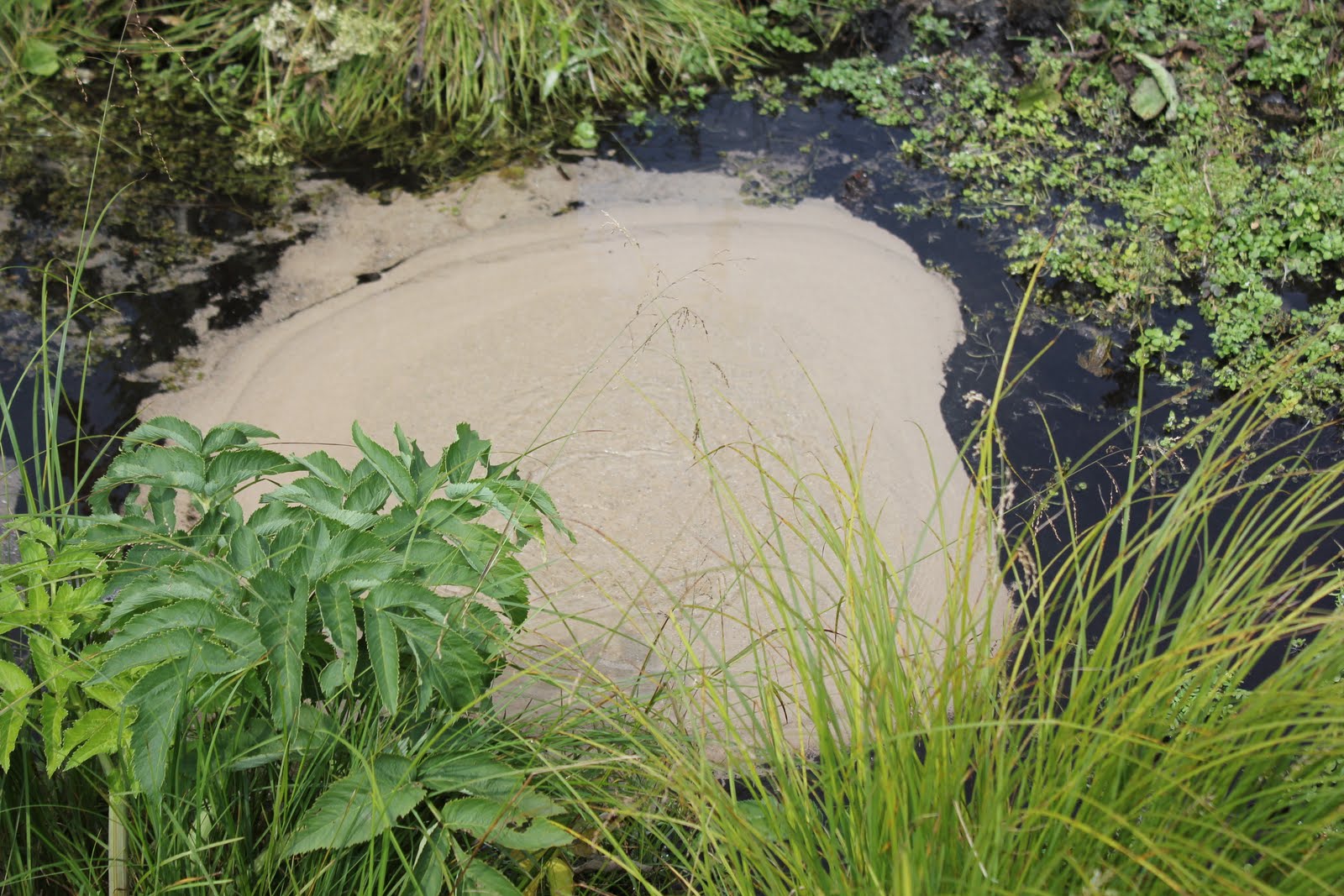
Nachusa Sand Boil 2011


One of the fun natural features at the Nachusa Grasslands is a sand boil.  Sand deposits from the Wisconsin era of the Ice Age are evident in many places at Nachusa, such as the sandstone outcroppings. 

The sand boil at Nachusa occurs at a natural spring.  It is caused when water under pressure pushes up through a bed of sand.  This sand boil is active in every season, even winter!

Animal-eating Plants!

During a trip to Pokagon State Park (Indiana), I learned about a carnivorous plant called Common Bladderwort.  It's a small, innocent-looking plant that you could easily miss. 

Apparently, the deadly part is underwater -- "little bags" or bladders that trap aquatic organism. Tiny swimming animals touch trigger hairs around the mouth of a bladder. A trap door opens and the bladder expands, sucking the prey inside. 

Common Bladderwort is found in bogs and marshes throughout North America, so watch out!